Handbuilding Pottery: Beginner Techniques
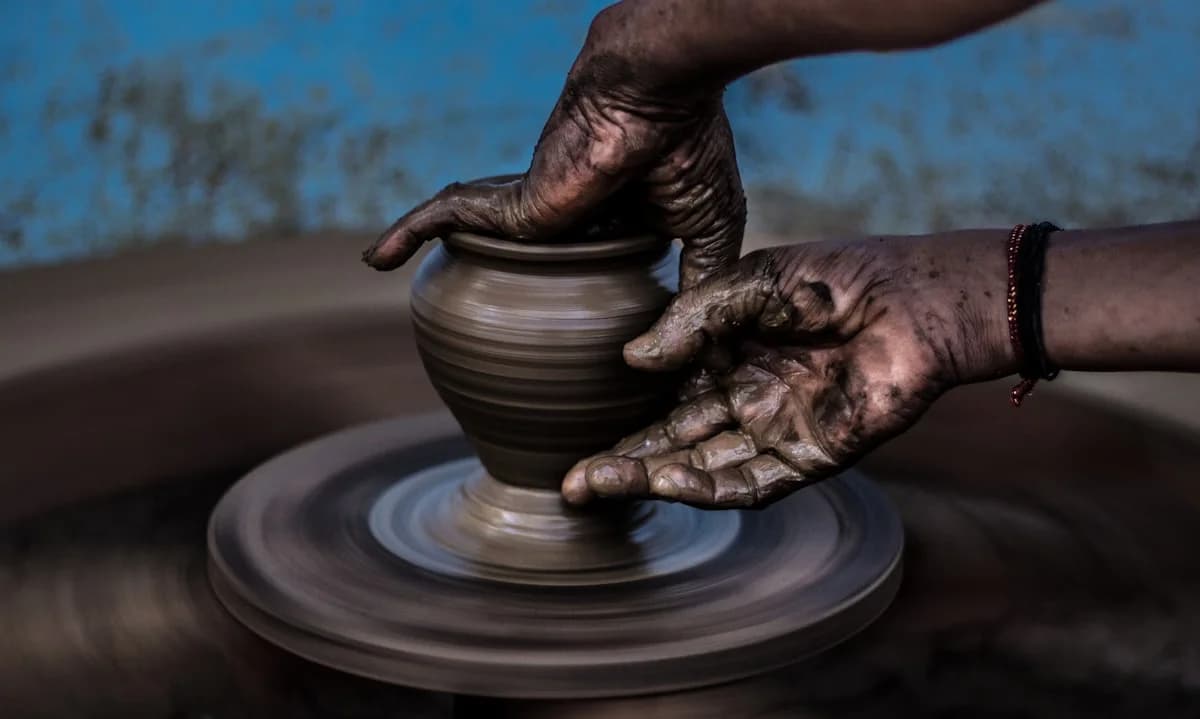
Handbuilding is one of the oldest and most accessible forms of pottery. Long before the invention of the wheel, humans shaped clay with their hands to create vessels, sculptures, and functional objects. Today, handbuilding remains a vital ceramic technique, offering creative possibilities that wheel throwing simply cannot match.
Why choose handbuilding?
Advantages over wheel throwing
- No equipment needed: Just clay, basic tools, and your hands
- Any shape possible: Not limited to round, symmetrical forms
- Slower pace: More time to consider design decisions
- Accessible: Great for beginners, children, and those with mobility issues
- Expressive: Direct hand-to-clay connection
When to use handbuilding
| Project type | Why handbuilding works |
|---|---|
| Sculptural pieces | Complex, asymmetrical forms |
| Square/rectangular | Impossible on the wheel |
| Large pieces | Easier to manage than wheel |
| Textured surfaces | More control over surface |
| Tiles and flat work | Consistent thickness |
| Teaching beginners | Immediate success |
"Handbuilding connects us to thousands of years of ceramic tradition. Every culture has shaped clay by hand." - Ceramic artist
Essential handbuilding tools
Basic toolkit
- Rolling pin: For even slab thickness
- Wooden ribs: Smoothing and shaping
- Metal ribs: Refining surfaces
- Wire cutter: Cutting clay
- Needle tool: Scoring, trimming, detail work
- Sponge: Smoothing and moistening
- Slip: Clay "glue" for joining pieces
- Canvas or cloth: Work surface for slabs
Optional but helpful
- Slab roller: Consistent slab thickness
- Extruder: Uniform coils and handles
- Texture tools: Stamps, rollers, found objects
- Templates: For consistent shapes
The three main techniques
1. Pinch pots
The most ancient and intuitive technique.
Basic pinch pot process
Starting:
- Roll clay into smooth ball (tennis ball size)
- Cup in non-dominant hand
- Press thumb into center, stopping 1/4" from bottom
Shaping:
- Rotate ball slowly in hand
- Pinch between thumb (inside) and fingers (outside)
- Work from bottom up
- Maintain even wall thickness
- Smooth as you go
Finishing:
- Even out rim
- Smooth interior with finger or tool
- Refine exterior shape
- Add foot or base if desired
Pinch pot variations
Closed forms:
- Join two pinch bowls rim-to-rim
- Create spheres, pods, rattles
Altered shapes:
- Stretch, pull, and distort
- Create organic, flowing forms
Combined with other techniques:
- Add coil necks to pinch bases
- Apply slab handles or feet
Common pinch pot problems
| Issue | Cause | Solution |
|---|---|---|
| Uneven walls | Inconsistent pinching | Work systematically, feel thickness |
| Cracking rims | Too dry | Keep rim moist with sponge |
| Collapsing | Walls too thin | Support with hand inside |
| Thick bottom | Not enough initial pressing | Start deeper |
2. Coil building
Build forms by stacking ropes of clay.
Making coils
Hand rolling:
- Start with clay rope
- Roll with flat palms on canvas
- Work from center outward
- Apply even pressure
- Aim for consistent diameter
Tips for even coils:
- Use softer clay
- Roll with whole palm, not just fingers
- Keep clay from sticking with light dusting
- Practice makes perfect
Basic coil construction
Building the base:
- Roll slab for bottom, or
- Coil spiral from center outward
- Smooth and blend coils together
- Let firm up slightly
Adding walls:
- Score edge of base
- Apply slip to scored area
- Place first coil on edge
- Blend inside (outside optional for texture)
- Score top of coil
- Add next coil, offset join from previous
- Repeat, building upward
Shaping with coils
Widening: Place coils slightly outside previous Narrowing: Place coils slightly inside previous Straight walls: Stack directly on top
Finishing coiled pieces
Smooth finish:
- Blend all coils completely
- Use rib to smooth exterior
- Refine with scraping and sponge
Textured finish:
- Leave exterior coils visible
- Blend only interior
- Creates distinctive handmade look
3. Slab construction
Build with flat sheets of clay.
Making slabs
Rolling by hand:
- Flatten clay ball
- Place between canvas sheets
- Use rolling pin with guide sticks for thickness
- Roll in multiple directions
- Flip and rotate to prevent sticking
Slab roller:
- Faster and more consistent
- Essential for production work
- Adjust for desired thickness
Slab thickness guide
| Project | Recommended thickness |
|---|---|
| Small tiles | 1/4" (6mm) |
| Large tiles | 3/8" (10mm) |
| Small boxes | 1/4" (6mm) |
| Large vessels | 3/8-1/2" (10-13mm) |
| Sculptural work | Varies by size |
Slab construction methods
Soft slab:
- Flexible, can drape over/into forms
- Good for organic shapes
- Work quickly before it stiffens
Leather-hard slab:
- Holds shape when stood up
- Best for boxes, geometric forms
- Cut with precision
Joining slabs
The process:
- Cut pieces to size
- Bevel edges for stronger joins
- Score both surfaces to be joined
- Apply slip liberally
- Press firmly together
- Support while drying
Reinforcing joints:
- Add coil to inside corners
- Blend thoroughly
- This prevents cracking at seams
Slab projects
Beginner:
- Tiles and coasters
- Simple trays and dishes
- Textured wall pieces
Intermediate:
- Boxes with lids
- Vases and planters
- Mugs and cups
Advanced:
- Complex architectural forms
- Large sculptural pieces
- Interlocking components
Combining techniques
The magic happens when you combine methods:
- Pinch + coil: Pinch pot base with coil-built neck
- Slab + coil: Slab box with coil handles
- Pinch + slab: Pinch forms with slab additions
- All three: Complex sculptures using every technique
Surface decoration
Before leather-hard
- Paddling: Shape and texture with paddles
- Impressing: Press objects into surface
- Carving: Remove clay for design
- Adding: Attach clay for relief
At leather-hard
- Burnishing: Polish with smooth tool
- Incising: Cut lines into surface
- Sgraffito: Scratch through slip layer
- Faceting: Cut flat planes into form
Drying handbuilt work
Critical considerations
Handbuilt pieces are prone to cracking because:
- Uneven thickness dries at different rates
- Joins are stress points
- Large flat areas warp
Best practices
- Dry slowly: Cover loosely with plastic
- Dry evenly: Rotate periodically
- Support curved pieces: Prevent warping
- Flip flat work: Dry both sides equally
- Check joins: Re-blend if cracks appear
Teaching handbuilding
Handbuilding is often the best starting point for pottery students. It requires no special equipment, allows for immediate creative expression, and builds fundamental clay skills. Whether you're teaching children or adults, beginners or advanced students, handbuilding techniques offer endless possibilities, and tools like Ceramik help pottery teachers organize their classes, track student projects, and manage their teaching schedule efficiently.
Manage your pottery studio
Ceramik is the app for teachers and studios to organize classes, students, and creative journeys.